The definition of Introvert, according to Google, is a "shy, reticent, and typically self-centered person." Notice that they are typically self-centered. This means that a lot of "Introverts" aren't just shy; they have "the fear of man" as Paul puts it in 1 Corinthians 4:3, "But with me it is a very small thing that I should be judged of you, or of man's judgment..."
Paul tells us in this verse that Christians have nothing to fear from other people. As most Introverts are selfish, Christians should mainly be free from this problem. Of course, just because you're a believer doesn't mean you're perfect, but it should not be as much of a problem.
Of course, the definition says "typically," not "always." So you can still be an Introvert and not be selfish? Yes, you can. Being shy doesn't always indicate self-centeredness. But I said I will be debunking the myths, and I will be. But according to the definition, the myths are true! Not really. You see, reticent is defined as "not revealing one's thoughts or feelings readily." This simply means "not loud mouthed and loudly opinionated." So, is that a bad thing? Nope.
So, what about shy? Here is where there is a slight difference in the definitions. I want to introduce a different "type" of Introvert: one who is social, friendly, likes to speak up, but needs alone time, and during the time that they're alone, they meet all the requirements of the definition. The real difference between an Introvert and an Extrovert is that an Introvert gets fuel from alone time, or time to think by themselves. They can still be social and talkative, but they need alone time. An Extrovert is someone who gets their fuel from making friends and being around people.
So, that fact pretty much debunks all stereotypes about Introverts (although probably a lot of Introverts are like that).
But let's get down to business. How do you become more outward facing? A hard question indeed.
The best way is to engage them in conversation. But how? Ask them questions. And not just "Hi, what do you like to do?" But things like "Hi, I like your suit. Do you dress fancy often?" Of course, it's hard to think of these things on the fly (for most Introverts), so here's a way to make some pre-scripted questions:
- Sit down and don't move your feet
- Make a list of things you would like talking about
- Make a list of current events that are being talked about
- Make a list of things you like to do/get
- Using one of these three lists, come up with questions, such as "Hi, My name is John. What's yours?" After they reply, ask them something like "have you heard of Amazon's Drone Program?" (This is a good question. Ask them their thoughts on it if they have, or tell them about it if they haven't and then ask them their thoughts.)
- Make a flow chart of possible answers to your favorite questions and memorize it
Here are some handy tips:
- Whenever someone shuts you down, think about your delivery. You might have been bugging them or have had the wrong timing. Try not to ask them questions when they're eating or drinking.
- A long line is an excellent place for conversations. Car trips are as well.
- Don't interrupt. Ever. It's extremely rude.
- Listening is also key. Make sure that you don't just try to get answers and move on.
- And for all Introverts: respect Extroverts.
Okay, so that's good for Introverts. But Extroverts: pay close attention, your part is coming up.
So what if you don't have any of those problems? What can you do about Introversion? Know the Introverts around you. If you are a good conversationalist, start a conversation and make it easy for them! Groups are the most intimidating thing for Introverts, since they never feel like they have anything to say. If you are in a group and someone seems to be just standing there and soaking everything in, see if you can change the discussion into going around the circle and telling jokes or something. An Introvert doesn't like to be put "on the spot" but won't mind as much in matters like that. Also, try to incorporate variety into the conversation. That way, the Introvert won't feel awkward when he interject with something random.
The best type of conversation to have with an Introvert is a one-on-one. If it's just you and them, they will feel more welcome to talk and will be (if only a little) more open. And don't ramble. Extroverts, this is for you: don't always be the one talking. If you are, the Introvert will feel like they are being used as a sort of recording machine. Most Introverts like civil argument. Not too much different from debate, "civil argument" is where you disagree on one point and discuss the differences and bring up facts. I was having a "civil argument" with one of my friends recently on which company was better, Amazon or Google. Everyone has an opinion on that. (Unfortunately, some lack the intellect to see the interest in such a "debate.")
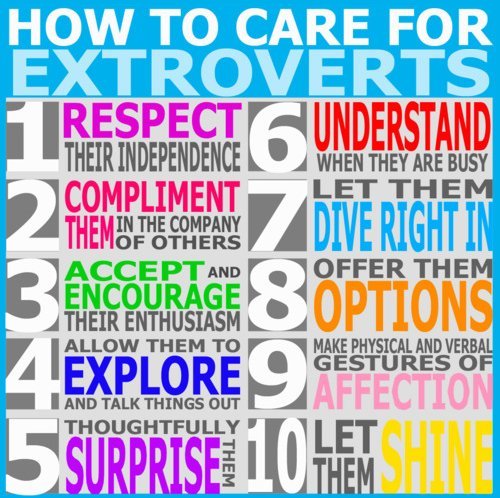
Of course, it's a good idea to talk about something you both like. A big mistake would be to talk about fashion when your Introvert friend is a "redneck" or to talk about anything outside when the other person prefers mental exercise. Yes, those people do exist. No, they are not "inferior." No, they are not "nerds." Yes, they can talk. But above all, respect introverts. This point cannot be stressed enough. Think, "If I was an extrovert, how would I want to be treated?" Here is a handy list.
To finish up, I hope this helped! Learn from Scripture and pray constantly if you have "the fear of man." Happy New Years! So, random question: according to the "new definitions" of Introvert and Extrovert, which category do you fall into?


No comments:
Post a Comment